Why accessible portable restrooms matter at Phoenix events and worksites
An accessible portable restroom is not just a bigger version of a standard porta potty. It changes whether a guest, worker, or vendor who uses a wheelchair or has limited mobility can use the restroom at all. At a wedding on a backyard lawn, a festival in a dusty lot, or a construction site where the ground is uneven, the difference between a standard unit and an accessible unit can be the difference between participation and exclusion.
In Phoenix, heat adds another layer. A person who uses a wheelchair may need more time inside a unit. A cramped standard porta potty is hard for anyone to manage in 105 degree weather, but for someone who cannot stand or pivot easily, it can be impossible. An accessible unit with more floor space and handrails gives that person room to move without pressing against hot plastic walls.
When you plan restrooms for any gathering, think about access before you think about count. One accessible unit placed on firm ground near the main activity is often more useful than two standard units tucked behind a curb or on a slope.
What an ADA accessible portable restroom typically includes
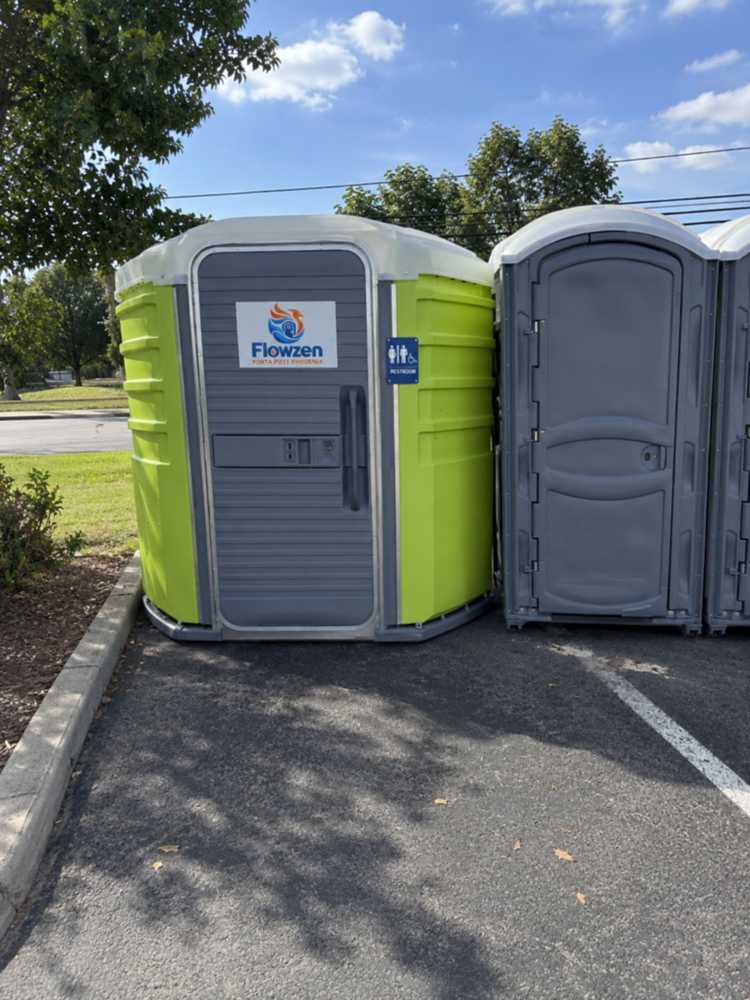
Portable restroom designs vary by manufacturer and rental company, so no two accessible units are exactly the same. Still, most accessible porta potties share a few features that set them apart from standard units.
- Ground-level entry or a low ramp: Most accessible units are built so a wheelchair can roll in without climbing a step. Some have a built-in ramp, others sit low enough that a small threshold ramp works.
- Wider door opening: The door is wider than a standard unit door, commonly wide enough for a standard wheelchair.
- More interior floor space: The inside is larger, often enough for a wheelchair to turn around. This is a big difference from a standard unit where there is barely room to stand.
- Grab bars: Handrails or grab bars are mounted near the toilet area to help someone transfer from a wheelchair to the seat.
- Lower toilet seat height: Many accessible units have a toilet seat height closer to wheelchair seat height, which makes transferring easier.
- Non-slip floor surface: The floor is often textured to reduce slipping, which matters when hands are wet or when monsoon rain tracks mud inside.
- Hand sanitizer or sink placement: Some accessible units include a hand sanitizer dispenser or a small sink placed within reach from a seated position.
These are common industry features, not a guarantee for any specific unit. Before you rent, call us and ask what the accessible units we offer include. Ask about door width, ramp style, interior dimensions, and whether the unit has a sink or only hand sanitizer.
The accessible route matters as much as the unit itself
An accessible portable restroom is only useful if a person using a wheelchair can actually reach it. The route from the parking area, sidewalk, or main event space to the unit needs thought.
Firm, level ground
Wheelchairs do not roll well through soft grass, deep gravel, sand, or mud. In Phoenix, many outdoor event spaces are decomposed granite or packed dirt. That can work if it is dry and compacted, but it can turn soft after a monsoon storm. Place accessible units on pavement, packed gravel, plywood, or a temporary mat system. If the only available spot is on grass, ask us whether we can place a ground protection mat or a temporary ramp platform.
No curbs or steps along the path
A single curb can stop a wheelchair user from reaching the unit. Walk the route yourself. Look for curbs, drainage channels, low walls, or garden edging. If there is a curb, you may need a portable ramp. The City of Phoenix may have rules about placing ramps or units on a public sidewalk or right-of-way, so check before you set anything on city property.
Shade and ventilation
Phoenix summer sun can make the inside of any porta potty extremely hot. An accessible unit takes longer to use, which means more time inside. Place the unit where it gets afternoon shade from a building, tree, or pop-up canopy. Keep the door facing away from direct afternoon sun when possible. Ventilation matters too. A unit placed against a wall with no airflow will heat up faster than one with open space around it.
How many accessible units should you plan for?
There is no single rule that fits every event, but the industry does have general guidance based on how many total portable toilets you rent. Many event planners use a simple approach: if you rent a block of standard porta potties, a portion of that block should be accessible units. The exact portion depends on your expected crowd, the event type, and any requirements from your venue, HOA, or local jurisdiction.
For a wedding with 80 guests, one accessible unit may be enough if it is placed near the reception area and the rest of the site is wheelchair friendly. For a festival with several hundred people spread across a large site, you may need accessible units in more than one location. For a construction site, OSHA has sanitation requirements for workers, and those requirements include considerations for accessible facilities. Do not guess. Call us and talk through your event size, site layout, and expected attendees. The right count is worked out by phone, not from a chart.
Also think about who is using the unit. An accessible unit is not reserved only for wheelchair users. It is also the better choice for people who use walkers, canes, or crutches, for parents helping small children, and for anyone who needs more room. If your event includes older adults, people recovering from injuries, or families with strollers, that changes how many accessible units make sense.
Placement tips specific to Phoenix weather and ground conditions
Phoenix sits in the Sonoran Desert, and the ground here is not like the Midwest or the East Coast. Caliche, hard packed dirt, and decomposed granite are common. That can be good for stability but bad for staking or leveling. Summer monsoon storms from June 15 to September 30 can drop sudden heavy rain, turning dry washes into running water and packed dirt into slick mud.
- Place accessible units on the highest, firmest spot available, not at the bottom of a slope where water pools.
- Check the forecast during monsoon season. A unit that is accessible at 10 AM may be surrounded by water at 4 PM.
- Use ground mats or plywood under the unit and along the path if the surface is soft or sandy.
- Face the door away from prevailing wind and blowing dust where possible.
- Keep the path clear of cords, hoses, tent stakes, and decorative items.
For events in the cooler months from roughly October through April, the ground is usually drier and firmer, but morning dew on grass can still make a slope slippery. Check the route in the morning, not just at noon.
What to confirm with us before you book
Accessibility is not something to assume. A unit labeled accessible in one fleet may have different dimensions or features than a unit from another company. When you call, ask specific questions.
| Question to ask | Why it matters |
|---|---|
| What are the interior dimensions of the accessible unit? | You need enough floor space for a wheelchair to turn. |
| Does the unit have a built-in ramp or do you need a separate ramp? | Ramps add setup time and may need extra ground space. |
| What is the door opening width? | Standard wheelchairs need a certain clearance, and some units are wider than others. |
| Does the unit include a sink or hand sanitizer? | Handwashing access matters for events with food or for worksite use. |
| How does servicing work for accessible units? | Ask about cleaning and restocking frequency for the length of your rental. |
| Can the unit be placed on soft ground or a slope? | We can tell you what surfaces work and what needs a mat or platform. |
Also ask about delivery. Accessible units are heavier and larger than standard porta potties. The delivery truck needs a clear path and enough room to maneuver. If your site has a narrow gate, low branches, or tight parking, mention that on the phone before the delivery day.
Accessibility is broader than the unit itself
Think about the whole restroom area, not just the portable restroom. Is there a handwashing station nearby that a wheelchair user can reach? Many portable handwashing stations are designed for standing use. If your accessible unit does not have a sink inside, place a handwashing station close by and check that the soap, water, and paper towel dispensers are within reach from a seated height.
Lighting matters for evening events. A dark path to a porta potty is hard for anyone, but for someone with limited vision or mobility, it is a real barrier. Use temporary lighting along the route and at the unit door. Keep the area clear of trash, empty cups, and cords.
Finally, avoid assuming legal compliance on your own. The term ADA accessible is widely used in the portable sanitation industry, but only the event organizer or site owner can determine whether their overall setup meets legal obligations. If you are organizing a public event, a workplace, or a venue open to the public, you may have specific duties. Check with your venue, your HOA, and local authorities. We can talk through the accessible units we offer, but the legal responsibility for your event rests with you.
For more planning help, read our article on how many porta potties you need and our guide to choosing portable restrooms for a wedding. If you are working on a job site, see portable toilets for construction sites. You can also look at the ADA accessible portable restroom rental page and the portable handwashing station rental page. When you are ready to talk through your event or project, call Flowzen Porta Potty Phoenix and describe your site, your expected crowd, and your access needs.
Ready for a quote? Call us at (602) 848-6242 with your date, location and headcount. We are open daily, 7 AM to 9 PM.
Frequently asked questions
What is the difference between a standard porta potty and an ADA accessible portable restroom?
An ADA accessible portable restroom is larger, with a wider door, ground-level entry or a low ramp, grab bars, and more interior floor space so a person using a wheelchair can enter, turn, and transfer to the toilet. A standard porta potty is smaller and typically requires stepping up into the unit.
How many ADA accessible portable restrooms do I need for my event?
There is no single rule. The right number depends on your total restroom count, expected attendees, site layout, and any venue or local requirements. Call us and describe your event so we can help you work out a sensible plan.
Can an ADA accessible portable restroom be placed on grass or dirt?
It can, but the surface must be firm and level enough for a wheelchair to roll. Grass, sand, and loose gravel can be difficult. You may need ground mats, plywood, or a temporary ramp platform, and we can advise you on what will work at your site.
Does renting an ADA accessible portable restroom make my event legally compliant?
Not by itself. Legal compliance depends on your whole setup, including the route to the unit, ground surface, number of units, and local requirements. Check with your venue, HOA, and local authorities, and confirm unit features with us by phone.