Start with the guest experience, not the unit count
A wedding portable restroom is not the same as a construction site porta potty. Your guests are dressed up. They may be carrying a drink, holding a child or helping an older relative. The restroom setup is part of the hospitality you provide, just like food, seating and shade. Before you count units or compare features, think about what your guests will actually encounter: the walk to the unit, the wait, the interior, the ability to wash hands properly. That sequence shapes their impression more than any single spec.
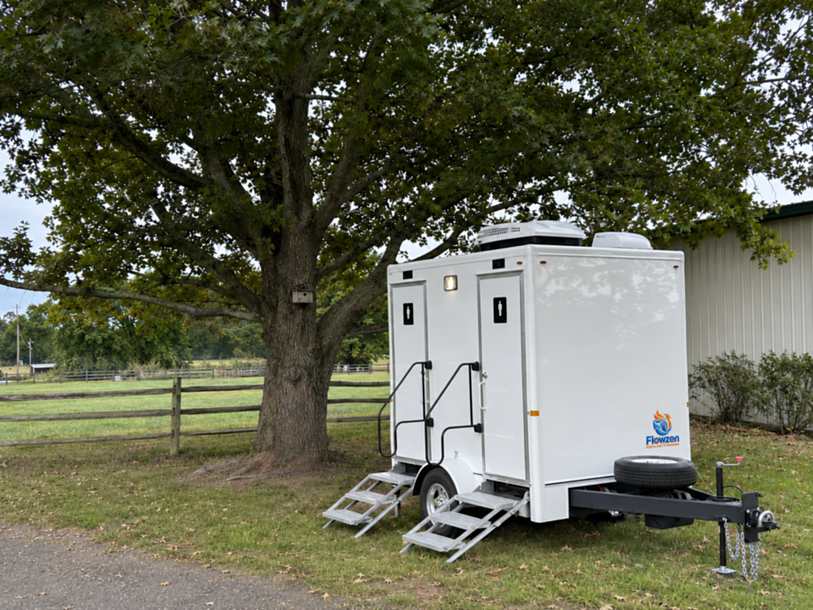
In the portable sanitation industry, wedding restroom planning usually starts with three categories: standard porta potties, deluxe units and ADA accessible portable restrooms. Standard units are what most people picture: a single stall with a holding tank, a urinal, a toilet paper dispenser and a vent pipe. They are functional and common. Deluxe units typically add a hand sanitizer station or a small foot-pump sink inside the stall, along with a mirror or a slightly roomier interior. ADA accessible units are larger, with a ground-level entry, grab bars and space for a wheelchair to turn. None of these are luxury restroom trailers. Trailers are a separate product category with flushing toilets, running water and climate control. If you want that, ask us whether we offer them. Not every company does.
Your choice among these types sets the baseline for comfort. For a casual backyard reception with 30 guests, a pair of clean standard units and a separate handwashing station can work well. For a 120-person wedding at a private estate, two or three deluxe units placed thoughtfully will feel more appropriate. The difference is partly about features and partly about perception. Guests at a wedding tend to expect something closer to a home bathroom experience, even when that is not possible outdoors.
Deluxe vs standard: what the upgrade actually means
The term "deluxe" is not regulated, so what it includes varies. In most cases, a deluxe portable restroom includes a hand sanitizer dispenser or a small sink that uses a foot pump to release water from a freshwater tank. Some have a mirror. The interior is often a little wider than a standard unit. The exterior may look the same. The real value at a wedding is the sink. Guests who can wash their hands inside the unit do not need to visit a separate station afterward, which reduces congestion and makes the experience feel more complete.
Standard units are simpler. They commonly include a toilet seat, a urinal, a toilet paper holder and a vent. They do not have running water. For a wedding, pairing standard units with a dedicated portable handwashing station is the practical minimum. Handwashing stations are standalone fixtures with a foot pump, a freshwater tank, a soap dispenser and paper towels. They serve multiple users and are placed near the restroom cluster.
When you call us, ask what each unit type includes. Do not assume a deluxe unit has a sink. Confirm it. Ask about the freshwater capacity and whether the sink is inside the stall or outside. These details matter when guests are in formal clothes and the temperature is high.
For more on the differences, read our article on standard vs deluxe porta potties.
ADA accessible restrooms are not optional
If your wedding includes any guest who uses a wheelchair, a walker or has limited mobility, you need at least one ADA accessible portable restroom. Even if you are not sure, it is safer to include one. These units are designed with a wider door, a flat or ramped entry and interior grab bars. They provide enough floor space for a wheelchair to turn around. A standard unit cannot accommodate that.
The term "ADA accessible" describes a design intent. Whether a specific unit meets all current requirements for your event depends on placement, path of travel, door hardware and other factors. We recommend you discuss accessibility needs directly with us and confirm how many accessible units are appropriate for your guest count. We can explain what our accessible units offer and how they are typically deployed.
Placement matters as much as the unit itself. An accessible restroom on uneven ground, soft grass or gravel is not truly accessible. Plan for a stable, level surface and a clear path from the main event area. If the ground is sloped or sandy, ask us about ramps or ground mats. For a deeper look at this topic, see our guide on ADA accessible portable restrooms.
Handwashing changes everything
At a wedding, guests eat, drink, shake hands and handle their phones. Handwashing is not a nice-to-have. It is a basic expectation. A portable handwashing station placed next to the restrooms gives guests a dedicated spot to wash with soap and water. These stations typically hold several gallons of fresh water and include a foot pump, a soap dispenser and paper towels. One station can serve multiple standard units.
Deluxe units with built-in sinks reduce the need for a separate station, but they do not eliminate it entirely. If you have several units grouped together, a shared handwashing station still helps move people through faster. For a larger wedding, place a handwashing station near the food area as well. Guests appreciate being able to clean their hands before eating without walking back to the restroom cluster.
In Phoenix, handwashing also helps with heat hygiene. Sweat, sunscreen and dust are part of any outdoor event in the desert. Clean hands make everything more comfortable. Read more about setup and placement in our article on handwashing stations for outdoor events.
Placement, screening and the desert sun
Where you put the restrooms affects how they feel inside. In Phoenix, a portable restroom placed in direct afternoon sun can become uncomfortably hot inside, even during the cooler months. The plastic enclosure absorbs heat. Ventilation helps, but shade is better. Place units on the north or east side of a building, under a tree canopy or behind a shade structure if possible. If natural shade is not available, consider renting a pop-up canopy or placing units where they will catch the prevailing breeze.
Screening is about both privacy and appearance. Guests do not want to feel like they are walking into a construction site. Use fabric panels, lattice screens, potted plants or rented barriers to create a visual buffer between the restroom area and the main event space. The walkway should be obvious and well-lit, but the units themselves do not need to be on display. Even a simple arrangement of tall plants in pots can soften the look.
Also think about the walk. Guests in heels or dress shoes will struggle with loose gravel, deep grass or uneven dirt. A temporary walkway made of plywood, outdoor rugs or rented matting makes the path cleaner and safer. If the ground is sloped, level the units with blocks or ask us about placement on uneven terrain.
Lighting and after-dark use
Most weddings go into the evening. Guests need to find the restrooms and feel safe using them. Battery-powered LED lights placed inside each unit are a simple solution. We can tell you whether we provide these when you call. If not, you can buy stick-on, motion-sensor lights and place them yourself the morning of the event. Outside the units, solar path lights or string lights leading to the restroom area make the route obvious and inviting. Avoid bright floodlights that kill the mood. Soft, warm light is enough.
Inside the unit, a small light makes a big difference. Guests can see the latch, find the toilet paper and avoid fumbling in the dark. If you are using standard units without a mirror, a small adhesive mirror inside the door is a thoughtful touch that costs very little.
Timing the delivery and setup with your vendors
Portable restrooms should arrive after major site work is done but before other vendors need them. If you are having a tent installed, have the tent up first so the restrooms can be placed nearby without blocking the crew. If catering is setting up tables and chairs, coordinate so the restroom path does not cross the kitchen prep area. We will need a clear access route for the delivery truck. Make sure gates are unlocked, vehicles are moved and the placement spot is marked.
In Phoenix, the cooler months from October through April are the busiest wedding season. Rental schedules fill up. Call well ahead of your date to discuss availability. The monsoon season, officially June 15 to September 30, brings dust storms and sudden heavy rain. If your wedding falls during those months, talk with us about how units are secured in wind and whether extra servicing makes sense after a dust storm. Units placed on dirt may need to be repositioned if the ground turns to mud.
For more on rental timing and logistics, see our article on how long you can rent a porta potty.
Working out the right number and configuration
There is no single formula that fits every wedding. Industry guidance exists for events: a certain number of units per number of guests, with adjustments for event duration and alcohol service. But the right count for your wedding depends on guest count, length of reception, whether you are serving alcohol, and how many units are deluxe versus standard. A common starting point for a 100-guest wedding with alcohol and a four-hour reception is two standard units, one deluxe unit, one ADA accessible unit and one handwashing station. That is a starting point, not a rule.
What matters is that guests never wait in a long line. A queue of people in formal clothes standing outside a porta potty is a clear sign of under-planning. If your guest count is near a threshold, round up. The marginal cost of one more unit is small compared to the impact on guest comfort.
For a more detailed breakdown of counts and ratios, read our article on how many porta potties you need.
Questions to ask when you call us
When you are ready to reserve units, a phone call is the way to get real answers. You cannot book online, and that is actually helpful: a conversation lets you describe your site, your guest list and your concerns. Here are practical questions to cover.
| Topic | What to ask |
|---|---|
| Unit features | What exactly does your deluxe unit include? Does it have a sink inside? |
| Accessibility | How many ADA accessible units do you recommend for my guest count? What surface do they need? |
| Handwashing | Do you provide handwashing stations separately? How much freshwater do they hold? |
| Servicing | What is your standard servicing schedule? Can you service the morning of the event? |
| Delivery | When do you typically deliver for a weekend wedding? What access do you need? |
| Heat and weather | What do you recommend for units placed in full sun? How do you handle monsoon wind? |
| Placement | Can you place units on a slope or soft ground? Do you provide leveling? |
Every wedding site is different. A city backyard has different constraints than a desert lot on the edge of the Valley. We can talk through your specific situation by phone. Flowzen Porta Potty Phoenix discusses all of these points with customers when they call. We can help you work through the restroom options for your event and confirm what is available for your date. If you are planning a Phoenix wedding, call to talk through your setup before you finalize other vendor contracts. The restrooms are easy to overlook until the week of the wedding, and by then the best options may be booked.
Ready for a quote? Call us at (602) 848-6242 with your date, location and headcount. We are open daily, 7 AM to 9 PM.
Frequently asked questions
Do you offer portable restrooms for weddings?
Yes, we provide standard porta potties, deluxe units, ADA accessible portable restrooms, handwashing stations and luxury restroom trailers. Call us to talk through your wedding setup and we can help you decide what fits your guest count and site.
How many portable restrooms do I need for a 100-guest wedding?
A common starting point is two standard units, one deluxe unit, one ADA accessible unit and one handwashing station. The right count depends on event length, alcohol service and your guest mix. We can confirm the final number when you call.
Can I use standard porta potties at a wedding?
Yes, especially for casual or smaller weddings. Pair them with a portable handwashing station and place them out of direct sun. For more formal events, deluxe units with a sink inside feel more appropriate.
Do I need an ADA accessible portable restroom at my wedding?
If any guest uses a wheelchair or has mobility limitations, yes. Even if you are unsure, including one is a safer choice. Call us to discuss accessibility needs and placement.
How do I keep portable restrooms cool at a Phoenix wedding?
Place units in shade, on the north or east side of structures. Ventilation helps, but shade is the biggest factor. For monsoon-season weddings, ask us about securing units against wind and dust.