Start With the Site Map and Crowd Flow
Before you count units, walk the festival site with a map in hand. Large festivals in Phoenix can sprawl across parks, fairgrounds, or blocked-off streets. The goal is to place portable restrooms where people naturally gather, not tucked away in a far corner where they get ignored until a line forms at the one visible bank.
Identify the main crowd magnets: entry gates, main stages, food vendor rows, beer gardens, kids' zones, and seating areas. Each of these zones will generate demand in pulses. A stage area empties between sets and sends a wave of people toward the nearest restrooms. Food courts see steady traffic for hours. We suggest placing restroom banks within a short walk (think 100 to 200 feet) of each major zone, but not so close that odor or crowding ruins the experience of eating or watching a show.
Also think about how people move between zones. If the main path from parking to the festival entrance is a half-mile walk, a small restroom bank near the entrance can catch people before they even step inside. Similarly, exit routes at closing time see a final surge. A bank near each exit gate reduces the bottleneck.
Restroom Banks: Grouping Units for Capacity and Flow
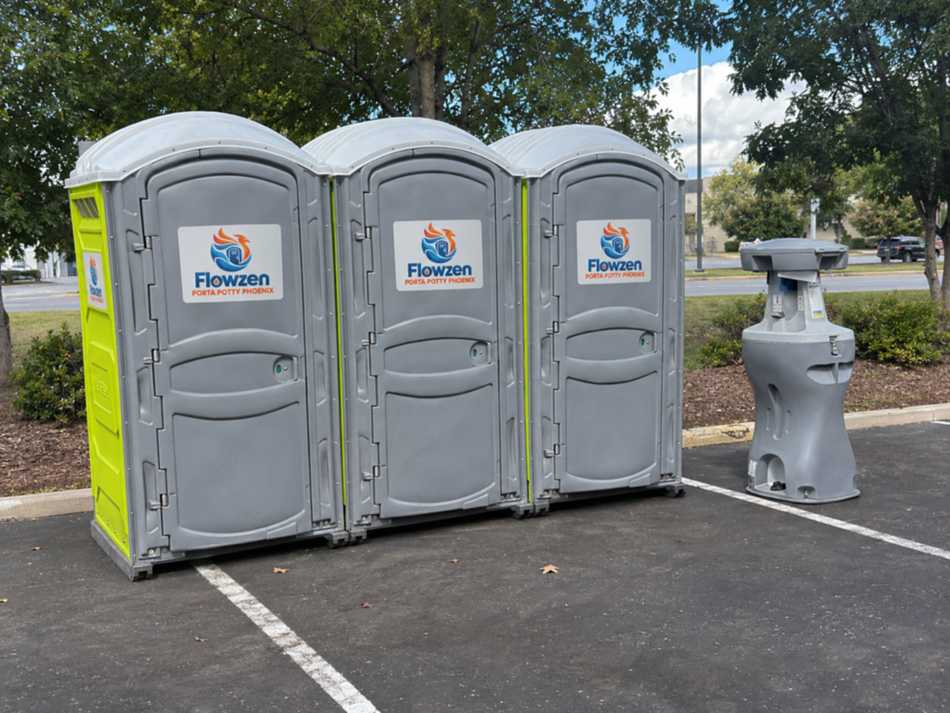
Instead of scattering single units across the site, we recommend grouping portable toilets into banks. A restroom bank is simply a cluster of units placed together. This approach has several advantages for a large festival:
- Shorter perceived wait times. A single line feeding multiple units moves faster and feels more organized than several separate lines.
- Easier servicing. A service truck can access one location instead of weaving through crowds to reach scattered units.
- Better visibility. A bank with signage is easier to spot from a distance.
- Gender-neutral efficiency. Most portable restrooms are single-occupancy, so a bank naturally serves everyone without separate lines.
How many units per bank depends on the zone's expected crowd. A main stage area for a festival drawing 5,000 people might need a bank of 20 to 30 standard units, while a secondary stage or vendor area might need 8 to 12. The exact count is something we work out with you based on expected attendance, event hours, and whether alcohol is served (which increases usage). You can read more about general counting guidance in our article on estimating the number of units for an event.
Placement Tips for Restroom Banks
- Keep banks on level, firm ground. Avoid loose sand or gravel that makes units unstable.
- Face doors away from main pedestrian traffic and food areas.
- Leave room for a line to form without blocking walkways.
- In Phoenix, place banks where they get afternoon shade if possible. A unit sitting in direct sun all day becomes extremely hot inside. Natural shade from buildings or trees helps. If shade is scarce, consider temporary shade structures over the bank.
Peak Demand: When Everyone Goes at Once
Festival restroom demand is not a steady curve. It spikes. The biggest surges typically happen:
- Between sets at music stages
- During intermissions or scheduled breaks
- Right after the gates open and people finish their first drink
- During the final hour as crowds prepare to leave
Plan unit numbers for the peak, not the average. A bank that looks oversized at 2 p.m. may be overwhelmed at 5 p.m. If your festival runs multiple days, watch how demand patterns shift. A Saturday crowd may be larger and stay longer than a Friday evening crowd, so Saturday needs more units even if the same number of tickets were sold.
One practical step: we suggest placing a few extra units near the busiest zones that can be opened if needed. Having two or three units on standby, serviced and ready, gives you flexibility without committing the full rental from day one. When you call us, we can talk about keeping a small reserve on site for large festivals.
ADA Accessible Units: More Than a Checkbox
ADA accessible portable restrooms are larger units with a ground-level entry, a wider door, and interior grab bars to accommodate a wheelchair or a person with limited mobility. For a large festival, these units are not optional extras. We recommend including them in every restroom bank, not in a single separate location.
A common mistake is placing one ADA accessible unit near the entrance and calling it done. A person using a wheelchair should not have to travel across the entire festival to find a restroom they can use. Include at least one ADA accessible unit in each major bank, and make sure the path to it is firm, stable, and at least 36 inches wide with no steps or steep slopes.
The number of accessible units needed depends on total attendance and site layout. Industry guidance suggests a percentage of total units should be accessible, but the right number for your specific festival is something to confirm with us and any local permitting office. For a deeper look at features and placement, see our ADA accessible portable restrooms guide.
Handwashing Stations and Vendor Zones
Handwashing is not just a nice add-on at a festival where people eat, drink, and touch shared surfaces all day. Portable handwashing stations with fresh water, soap, and paper towels should be placed in two key spots: directly next to restroom banks and directly next to food vendor areas.
At restroom banks, we recommend at least two handwashing stations per bank so people can wash hands without creating a secondary line. Near food vendors, place stations at both ends of the vendor row and one in the middle if the row is long. Festival guests are more likely to wash before eating if the station is right there, not a hundred feet away.
Handwashing stations need their own servicing schedule. Fresh water runs out, gray water tanks fill up, and soap and towels need restocking. For a multi-day festival, plan for at least daily servicing of handwashing stations, and more often in high-traffic areas. You can learn more about placement and options on our handwashing stations page.
Servicing Access: The Hidden Logistics Layer
A large festival running two or three days cannot rely on a single pre-event pump-out. Units need servicing during the event, sometimes more than once per day depending on crowd size and heat. This means service trucks need clear, dedicated access lanes to reach every restroom bank without driving through crowds.
During site layout, mark service routes on the map. These routes should be wide enough for a truck (typically 10 to 12 feet) and kept clear of vendor tents, stages, fencing, and pedestrian walkways. We suggest scheduling servicing for low-traffic hours: early morning before gates open, or during a scheduled break when crowds are at stages and away from restroom banks.
In Phoenix's summer heat, holding tank odor builds faster, and consumables like toilet paper and hand sanitizer get used more heavily. Daily servicing is common for large warm-weather festivals. When you call to discuss your event, we can confirm the servicing schedule, access requirements, and what is included.
Heat and the Phoenix Factor
Phoenix sits in the Sonoran Desert. From May through September, daytime highs routinely pass 100 F and can reach 110 F or more. Inside a portable restroom, temperatures can climb even higher, especially if the unit sits in direct sun with limited airflow. This affects both guest comfort and unit conditions.
Several steps help manage heat:
- Shade placement. As mentioned earlier, position units under existing shade or add temporary shade structures. Even a pop-up canopy over a restroom bank lowers interior temperatures noticeably.
- Ventilation. Standard units have a vent pipe that helps with airflow. Make sure nothing blocks the vents. Placing units so prevailing breezes hit the vent side can improve air movement.
- Extra servicing. Heat accelerates odor and increases liquid consumption (people drink more water). More frequent pump-outs and restocking keep units usable.
- Handwashing stations with cool water. In extreme heat, guests appreciate being able to splash cool water on their face and neck. It is a small detail that improves the overall experience.
Monsoon season runs June 15 through September 30, bringing dust storms and sudden heavy rain. Secure units so they cannot tip in high winds. Placing units on firm ground and using stakes or weights if we provide them helps. Also check that service access routes remain passable after a downpour. Dirt paths can turn to mud quickly.
Multi-Day Logistics: Keeping Things Fresh
A single-day festival has one arc: setup, event, teardown. A multi-day festival adds the challenge of overnight conditions and next-day readiness. Units used heavily on Saturday need to be clean and stocked by Sunday morning.
Overnight servicing is the backbone of multi-day restroom planning. Work with us to schedule a pump-out, cleaning, and restock window between the end of one day and the start of the next. This window may be tight. If the festival ends at 11 p.m. and gates reopen at 10 a.m., the service crew needs clear access and enough time to work through every bank.
Also consider overnight security. Restroom banks can attract vandalism or unauthorized use if the site is not fully secured. Fencing, lighting, or security patrols near restroom areas protect the units and the servicing investment.
For festivals spanning three or more days, some organizers rotate restroom banks. They might close one bank for deep cleaning while directing guests to an adjacent bank, then swap the next day. This requires extra units and careful signage but keeps conditions from degrading over a long weekend.
Cooler months (roughly October through April) are Phoenix's peak outdoor event season. Many large festivals happen during this window. The milder temperatures reduce heat-related stress on units, but all the other planning factors (placement, peak demand, servicing access, ADA units, handwashing) still apply. A well-planned restroom layout in November needs the same strategic thinking as one in March.
Working With Us on Your Festival
A large festival restroom plan comes together fastest when you talk through the details directly. Share your site map, expected attendance, event hours, and any special conditions like limited access or HOA rules. We can help you settle on unit counts, bank locations, servicing schedules, and the right mix of standard units, deluxe units with added features, and ADA accessible units.
When you are ready to plan portable restrooms for a festival in the Phoenix area, call Flowzen Porta Potty Phoenix. We can talk through your event layout, the restroom options that fit, and a servicing plan that works for a multi-day schedule. You can also browse our festival rentals page for an overview of what goes into a large event setup.
Ready for a quote? Call us at (602) 848-6242 with your date, location and headcount. We are open daily, 7 AM to 9 PM.
Frequently asked questions
How far apart should restroom banks be placed at a large festival?
We recommend placing a restroom bank within a 100 to 200 foot walk of any major gathering zone such as stages, food courts, or seating areas. The exact distance depends on your site layout, but guests should not have to search or walk far from the main action.
How many ADA accessible portable restrooms does a large festival need?
The number depends on total attendance and site layout, but a good practice is to include at least one ADA accessible unit in every major restroom bank. Confirm the specific count and placement with us and any local permitting requirements.
How often should portable restrooms be serviced during a multi-day festival?
For a large festival, daily servicing is common, and high-traffic banks may need attention more than once per day. In Phoenix heat, more frequent pump-outs and restocking help keep units usable. We suggest scheduling servicing during low-traffic hours like early morning.
Where should handwashing stations go at a festival?
Place handwashing stations directly next to every restroom bank and at both ends of food vendor rows, with an additional station in the middle if the row is long. This makes handwashing convenient after restroom use and before eating.