What a Standard Portable Toilet Actually Is
A standard portable toilet is a self-contained, single-stall unit built from lightweight plastic. It does not need electricity, a water hookup or a sewer connection. Inside, you will typically find a toilet seat over a holding tank, a urinal, a toilet paper dispenser and a hand sanitizer station. A vent pipe runs through the roof to help move air through the unit.
These units are the workhorses of construction sites, outdoor festivals, charity runs and backyard parties. They can be placed on dirt, gravel, asphalt or grass as long as the ground is reasonably flat. Because they are compact, they also fit into tighter spots that a trailer could not reach. On a hot Phoenix afternoon, the plastic shell absorbs a lot of sun, so placement in shade or under a canopy makes a real difference in user comfort. That is something we suggest thinking through when you walk a site, especially between June and September when the desert heat is at its peak.
Standard portable toilets are typically serviced on a schedule that keeps the holding tank pumped, the interior wiped down and supplies restocked. How often that happens depends on how many people use them and over how many days. Confirm the service plan with us when you call.
What a Luxury Restroom Trailer Brings
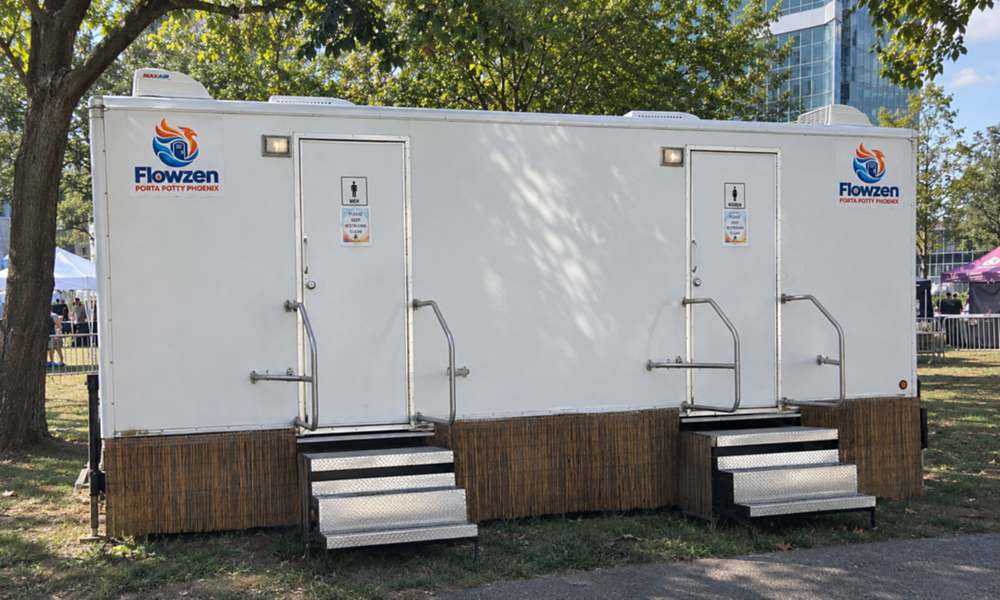
A luxury restroom trailer is a different category altogether. These are towable units with a finished interior that feels closer to a permanent restroom. You will commonly find separate stalls with locking doors, porcelain or high-gloss sinks, mirrors, running hot and cold water, climate control and flushable toilets. Some trailers include stereo speakers, wood-look flooring and accent lighting. The trailer is built on wheels with a low-profile deck and a fold-down step unit with handrails for entry.
Trailers are popular at weddings, corporate gatherings, anniversary parties and any event where guests are dressed up and expect a higher level of comfort. They also work well for long-term projects where a crew or client team will be on site for weeks and a standard unit does not match the site culture.
The tradeoff is logistics. A restroom trailer commonly requires a dedicated electrical connection, sometimes a 20-amp or 30-amp circuit, and a garden-hose-style water supply. Some trailers can run off an onboard freshwater tank and a generator, but that depends on the specific trailer. You also need enough level ground for the trailer itself and clearance for the delivery truck to maneuver it into place. In the Phoenix area, many venues and private properties can accommodate this, but it is not something to assume. Always walk the site and talk through the requirements with us before committing.
We have white restroom trailers with two separate doors. When you call, you can ask which trailer models are available and what power and water setups they support.
Key Differences at a Glance
The table below summarizes the main practical differences between a standard portable toilet and a luxury restroom trailer. This is based on what is common across the portable sanitation industry in the United States. Specific features, dimensions and requirements for any unit should always be confirmed directly with us.
| Feature | Standard Portable Toilet | Luxury Restroom Trailer |
|---|---|---|
| Power needed | None | Typically yes (confirm circuit size) |
| Water hookup needed | None | Commonly yes (some have onboard tanks) |
| Flushing toilet | No (holding tank directly below seat) | Yes, in most models |
| Sink with running water | No (hand sanitizer dispenser) | Yes |
| Climate control | No | Commonly yes (air conditioning and heat) |
| Interior finish | Plastic walls and floor | Finished walls, flooring, mirrors, lighting |
| Footprint | Small, fits tight spaces | Larger, needs level ground and clearance |
| Typical uses | Construction, casual outdoor events, backup | Weddings, corporate events, VIP areas, long-term upscale projects |
When a Standard Unit Makes More Sense
For many projects, a standard portable toilet is the practical choice. Construction sites are the most obvious example. The construction site rentals page covers how units are typically placed for crew access. A superintendent does not need running water in every unit, especially when a separate handwashing station can serve the whole site. Standard units are easy to move as the work zone shifts and they do not tie up a power source that is needed for tools.
Large outdoor gatherings like community festivals, charity walks and school carnivals often lean heavily on standard units as well. They can be spread across a park or fairgrounds in clusters, keeping lines manageable without the cost and complexity of powering a trailer at every location. The festival planning article goes deeper into layout and quantity.
Homeowners hosting a backyard graduation party or a casual barbecue also tend to choose standard or deluxe portable toilets. These keep party traffic out of the house and do not require running an extension cord across the yard. In the cooler Phoenix months from October through April, heat buildup inside the unit is less of a concern, which makes a standard unit more comfortable for a daytime gathering.
When a Restroom Trailer Is Worth the Extra Logistics
A luxury restroom trailer changes the feel of an event. For a wedding reception at a private residence or a desert venue outside the city, the trailer gives guests a climate-controlled space with running water, which matters a lot when the temperature climbs past 100 degrees. The separate stalls offer privacy that a single plastic unit cannot match. If the event runs into the evening and guests are in formal clothes, the trailer experience is closer to what they would expect indoors.
Corporate events and client appreciation parties are another situation where a trailer fits. The impression a restroom makes on guests reflects on the host, and a trailer with finished interiors, music and air conditioning communicates attention to detail. The wedding rentals page and the outdoor events page both discuss how restroom choice ties into the overall guest experience.
Some long-term commercial worksites also use trailers, especially when a project trailer or field office is already running power. A restroom trailer can serve a smaller, stable crew for weeks or months and reduce the number of standard units needed on site. It is worth talking through the servicing schedule and any water tank capacity limits so you know how often the trailer needs attention.
You can learn more about the trailer options on the luxury restroom trailer page. When you call us, have your site details ready: approximate guest or crew count, event dates, whether power and water are available within reach of where the trailer would sit, and whether the ground is hardpack, gravel, asphalt or turf.
Site Conditions in Phoenix That Affect Both Choices
The Sonoran Desert environment shapes how any portable restroom performs. In the summer, the inside of a plastic unit can become uncomfortably hot, especially if it sits in direct sun all afternoon. Placing a standard unit on the east side of a building or under a shade structure helps. For a restroom trailer, the air conditioning needs a reliable power source. A generator that struggles in 110-degree heat can cause problems, so the electrical plan deserves real attention.
Monsoon season, officially June 15 through September 30, brings sudden dust storms and heavy rain. Standard units need to be staked or weighted so they do not tip in high wind. Trailers need to sit on ground that will not turn soft and rutted after a downpour. If you are placing a trailer on a lawn or dirt lot, think about whether the delivery truck can get in and out without tearing up the ground if it rains the day before.
In the cooler months, when Phoenix sees the bulk of its outdoor weddings, charity galas and festivals, the weather is much more forgiving. That is when many hosts choose a trailer because the power and climate control are easier to manage and the trailer becomes a comfortable retreat rather than a necessity for survival.
Placement rules also vary. A unit or trailer placed on a public street or sidewalk in the City of Phoenix may need permission. HOAs and private venues often have their own requirements about where a restroom can sit and how long it can stay. Do not assume anything: check with the property owner, venue manager or HOA board before you finalize a rental.
How to Think Through the Decision
Start with the people who will use the restroom. A construction crew on a commercial worksite has different expectations than wedding guests. Next, look at the site. Is there a power source close enough to reach with a standard extension cord? Is there a water spigot? Is the ground level enough for a trailer? If the answer to any of those is no, a standard or deluxe unit paired with a handwashing station may be the cleaner solution.
Budget is obviously part of the conversation. A restroom trailer costs more to rent than a standard unit because of the equipment, the delivery and setup, and the servicing. That does not mean it is the wrong choice. It means the value it adds should match the occasion. For a one-time milestone event, many hosts find the upgrade worthwhile. For a long-running construction project, a trailer can sometimes replace several standard units and simplify servicing, but that math only works in certain situations.
Quantity is another factor. A single trailer with two stalls might serve a 50-person wedding. A 500-person festival needs a different approach, likely a mix of standard units and possibly a trailer for a VIP area. The guide on how many portable toilets you need walks through the reasoning, though the final count is something you work out by phone with us based on your specific event.
We talk through all of this when you call Flowzen Porta Potty Phoenix. We can help you weigh a trailer against standard or deluxe units, explain what power and water each trailer model needs, and figure out a service schedule that keeps everything running through your rental period.
Ready for a quote? Call us at (602) 848-6242 with your date, location and headcount. We are open daily, 7 AM to 9 PM.
Frequently asked questions
Do luxury restroom trailers need power and water at the site?
Most restroom trailers need a dedicated electrical circuit, often 20 or 30 amps, and a garden-hose-style water connection. Some trailers can operate with an onboard freshwater tank and generator. Confirm the exact requirements for the specific trailer when you call us.
Can a standard portable toilet be used for a wedding?
Yes, though many hosts pair standard units with a handwashing station or choose deluxe units that include a small sink. For formal weddings, a restroom trailer is a common upgrade because it offers climate control, running water and a finished interior.
How many standard portable toilets does a restroom trailer replace?
There is no fixed ratio. A trailer with two stalls serves two people at a time but provides a different experience than two standard units. The right mix depends on guest count, event length and whether you want the trailer for a specific area like a VIP section.
Can a restroom trailer be placed on a residential street in Phoenix?
Placing any unit or trailer on a public street or sidewalk may require permission from the City of Phoenix. Check with the city and your HOA if applicable. We can discuss typical placement practices when you call.